Patient monitoring is one of the defining skills of every EMS provider. Whether responding to chest pain, respiratory distress, trauma, or cardiac arrest, paramedics must quickly interpret changing vital signs and determine what those changes mean for patient care.
Learning this skill requires much more than memorising normal values. It demands experience recognising patterns, identifying deterioration, and making informed clinical decisions under pressure.
Traditionally, students develop these abilities during clinical rotations and simulation labs. However, access to training equipment is often limited.
A realistic online patient monitor allows learners to practice whenever they want, reinforcing classroom knowledge with hands-on experience. By working through dynamic patient scenarios, students gain confidence before they encounter similar situations in the field.
Live Vitals Tell the Story Before the Patient Does
Patients don't always describe their condition accurately. Some are unable to communicate because of altered mental status, severe illness, or trauma. In these situations, the monitor becomes one of the most valuable diagnostic tools available to EMS providers.
A changing heart rate, falling blood pressure, decreasing oxygen saturation, or increasing respiratory rate often signals deterioration before obvious physical symptoms appear. Experienced clinicians continuously watch these trends to anticipate problems rather than simply reacting when alarms sound.
Simulation provides an opportunity to practice recognizing these subtle changes repeatedly, allowing students to develop clinical instincts long before treating real patients.
Think Like a Paramedic While Watching a Patient Vitals Monitor
Learning to use a patient vitals monitor effectively means understanding how different vital signs influence one another. A single abnormal reading rarely tells the complete story. Instead, providers evaluate multiple parameters together while considering the patient's history, symptoms, and physical assessment.
For example, a patient with a slightly elevated heart rate may not initially seem unstable. However, if that increase is accompanied by falling blood pressure, rising respiratory rate, and declining oxygen saturation, the overall picture becomes much more concerning.
Practicing with realistic patient monitoring scenarios teaches students to connect these findings instead of focusing on isolated numbers. This approach develops stronger assessment skills while improving confidence during high-pressure emergencies.
Every Change Has a Cause—Learn to Interpret It
One of the biggest differences between beginner and experienced providers is the ability to explain why vital signs change.
A rapid heart rate may indicate pain, anxiety, dehydration, blood loss, fever, or shock. Low oxygen saturation could result from airway obstruction, pulmonary edema, asthma, or pneumonia. Elevated respiratory rates often represent the body's attempt to compensate for underlying illness.
Rather than memorizing countless values, students benefit from learning the physiology behind each change. Simulation encourages this type of critical thinking by presenting evolving patient conditions that require interpretation instead of simple observation.
With repetition, learners begin recognizing common clinical patterns that appear across multiple emergency scenarios.
Control Vital Signs to Recreate Real EMS Calls
Every EMS call unfolds differently. Some patients remain stable, while others deteriorate within minutes. The ability to control vital signs during simulation makes it possible to recreate these changing clinical situations without placing anyone at risk.
Instructors can gradually modify heart rate, blood pressure, respiratory rate, oxygen saturation, temperature, and ECG rhythms to match countless emergency presentations, including:
Because the patient's condition changes throughout the scenario, students learn to reassess continuously instead of relying on a single set of vital signs.
Use the Display Monitor to Track Patient Response to Treatment
Patient care does not end after making an initial assessment. Every intervention should produce a measurable response, and the display monitor helps providers determine whether treatment is working.
Administering oxygen should improve oxygen saturation in appropriate patients. Fluid resuscitation may increase blood pressure in hypovolemic patients. Certain medications alter heart rate or cardiac rhythm, while airway interventions influence respiratory status.
Watching these physiological responses develop in real time teaches students to evaluate treatment effectiveness rather than assuming every intervention succeeds automatically.
Continuous monitoring also reinforces one of the most important principles in EMS: reassessment never stops.
How to Read a Vital Signs Monitor During Time-Critical Emergencies
Understanding how to read a vital signs monitor requires a structured approach. Experienced EMS professionals avoid jumping directly to individual numbers. Instead, they work through a consistent assessment process.
Begin by observing the patient's overall condition before examining the monitor. Evaluate airway, breathing, and circulation first. Review ECG rhythm and heart rate, then compare blood pressure, respiratory rate, oxygen saturation, and temperature while considering how each value relates to the others.
Equally important is observing trends over time. A blood pressure that decreases steadily over several minutes often carries more clinical significance than a single low reading. Likewise, gradually worsening oxygen saturation may indicate respiratory fatigue even before severe symptoms become obvious.
Following the same systematic approach during every simulation helps students develop habits that transfer directly into real patient care.
Stop Memorizing Numbers Start Recognizing Patterns
Successful EMS providers recognize patterns rather than isolated abnormalities.
For example, a patient with chest pain, ST-segment elevation, increasing heart rate, and falling blood pressure presents a very different picture than someone experiencing anxiety despite similar symptoms.
Likewise, trauma patients often demonstrate predictable progression as blood loss increases. Respiratory patients show characteristic combinations of respiratory rate, oxygen saturation, and work of breathing.
Repeated simulation exposes students to these recurring patterns, allowing them to identify emergencies more quickly and respond with greater confidence.
Pattern recognition is one of the strongest predictors of effective clinical decision-making, and it improves significantly through consistent practice.
Why Continuous Monitoring Improves Clinical Confidence
Confidence does not come from memorizing textbook material—it develops through experience.
Each realistic monitoring session strengthens a student's ability to interpret changing patient conditions, prioritize interventions, and communicate findings clearly with instructors and teammates.
Simulation also provides a safe environment for making mistakes. Students can analyze incorrect decisions, understand why they occurred, and improve without compromising patient safety.
Over time, repeated exposure transforms uncertainty into confidence, preparing learners for both practical examinations and real emergency responses.
From Stable to Critical: Experience the Entire Patient Timeline
Real emergencies rarely remain static. Patients improve, worsen, compensate, and sometimes deteriorate rapidly.
Practicing complete patient timelines allows learners to experience these transitions from beginning to end. Instead of viewing a single snapshot of patient data, they observe how vital signs evolve throughout assessment, treatment, reassessment, and transport.
This dynamic approach teaches learners to anticipate deterioration, recognize treatment responses, and remain engaged throughout every stage of patient care.
These are the same skills that experienced paramedics rely on every day.
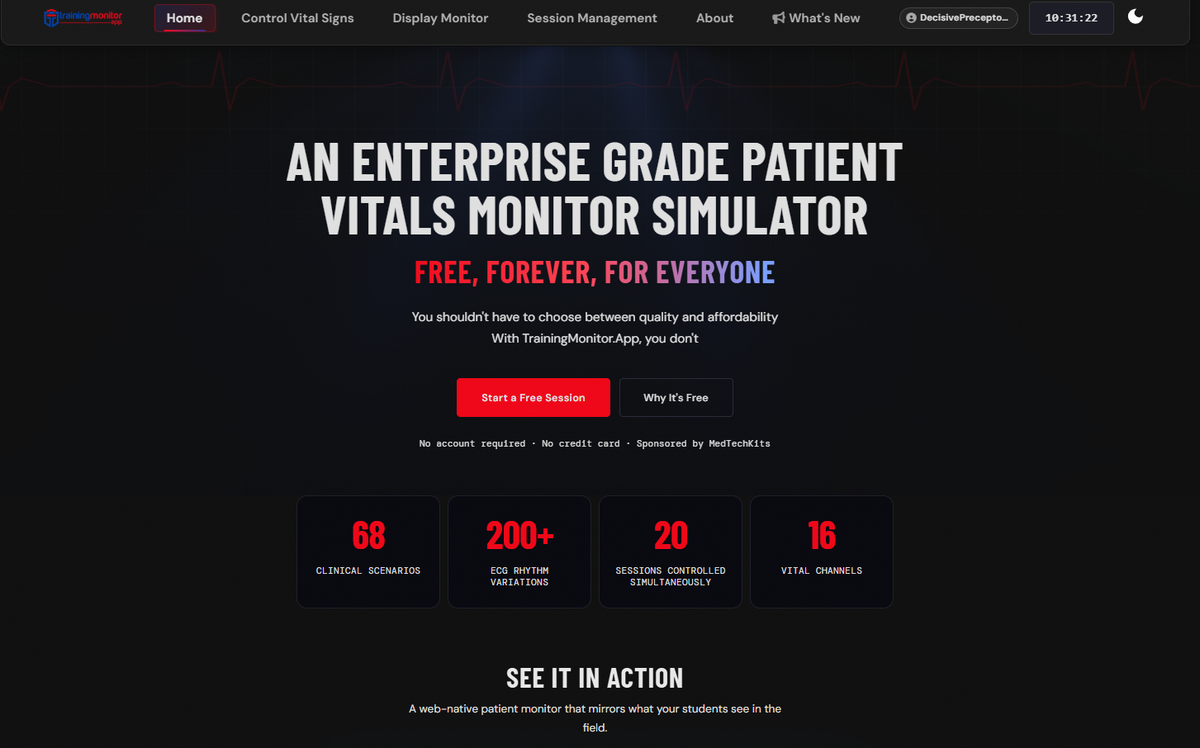
Practice EMS Monitoring Anytime With TrainingMonitor.app
Developing patient monitoring skills requires repetition, curiosity, and continuous learning. Every realistic scenario strengthens a provider's ability to recognize changing physiology, interpret monitor data, and make sound clinical decisions.
TrainingMonitor.app provides an interactive environment where EMTs, paramedic students, nursing students, educators, and healthcare professionals can practice realistic monitoring scenarios without specialized equipment. Whether you're reviewing ECG rhythms, studying patient trends, or preparing for your next skills assessment, regular practice builds confidence that carries into real clinical environments.
The best EMS providers don't simply watch monitors—they understand the story those monitors are telling. By practicing consistently, you'll learn to recognize subtle changes earlier, respond more effectively, and deliver better patient care when every second matters.