Anatomy of a Door That Never Complains
A door earns its reputation quietly, swinging for decades without applause, and the buyer who asks what materials a PVC MDF Door Factory actually uses is really asking how many silent decisions stand behind that silence. Contractors comparing ranges at haibodoor quickly learn that the answer arrives in layers, each one answering a different enemy such as moisture, impact, sound, or time. What hides behind the smooth face that brochures love to photograph?
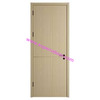
The outermost layer is the skin, and this surface answers the questions guests actually ask, since decorative PVC films arrive as thick thermoplastic membranes that vacuum pressing wraps around every routed panel, while melamine papers fuse under heat into a harder face that resists scratches from suitcases and vacuum handles. The skin carries the color story, from wood grains that fool the touching hand to solid colors that match minimalist interiors, and its quieter duty is moisture management, because a well bonded skin seals the board beneath against the humidity that swells lesser doors into jambs. Substrate choice sits directly under the skin, and medium density fiberboard earns its place here through a face smooth enough to take any foil without telegraphing the grain beneath, while moisture resistant grades of the same board guard humid coastal projects where ordinary fiberboard surrenders.
The Middle of the Story
The core occupies the middle of the story and divides families by weight, insulation, and cost, since solid particle cores fill the frame with dense material that deadens sound and carries hardware with confidence, while tubular chipboard cores drill rows of channels that lighten the leaf for bedrooms and closets where silence matters less than hinges do. Honeycomb paper structures answer the lightest briefs, filling the void with a cardboard geometry that stiffens the slab without loading it, and project buyers who read the weight of a sample door are reading the core's biography before a single spec sheet arrives. Frame species complete the skeleton, because solid wood stiles and rails, cut from pine or hardwood, give the hinges something to bite through years of swinging, and the species choice shows up at the latch plate where soft frames crush and hard frames shrug.
Specification honesty reveals the builder's habits, and haibodoor presents its PVC MDF Door Factory ranges with skin type, core construction, and frame species stated beside each model, which lets a contractor read a door's anatomy without visiting the plant, and the same pages disclose edge lipping thickness, the narrow solid strips that armor the long edges against trolleys and mops. Hardware reinforcement deserves its own line in the anatomy, since concealed blocks of solid timber behind the face give screws a grip that particle board never promised, and buyers who ask where those blocks sit learn quickly whether the factory expects its doors to carry real locks or merely to look like they do.
Material choice finally bends to climate and duty, because a hotel corridor punishes doors differently than a family bathroom does, and the factory that offers the full vocabulary of skins, boards, cores, and frames lets the project speak rather than the catalogue. Fire rated assemblies join the conversation where codes demand them, pairing cores and skins that test together as a system rather than as hopeful ingredients, and the documentation habit that accompanies such assemblies separates contractors who sleep well from those who chase certificates after the inspector leaves.
Years after the keys are handed over, the layers complete their argument in a corridor that never thinks about the door at all, since the skin still matches the walls, the core still muffles the meeting behind it, and the frame still meets the latch without negotiation, and every layer earns the same silent verdict. Contractors who specify by anatomy stop opening doors to check construction. Anyone writing a schedule for the next project can study the laminated builds at https://www.haibodoor.com, where skins, cores, and frames sit side by side in plain figures. Haibo Doors keeps each layer documented, and a door schedule sent across is usually returned with a material suggestion attached.