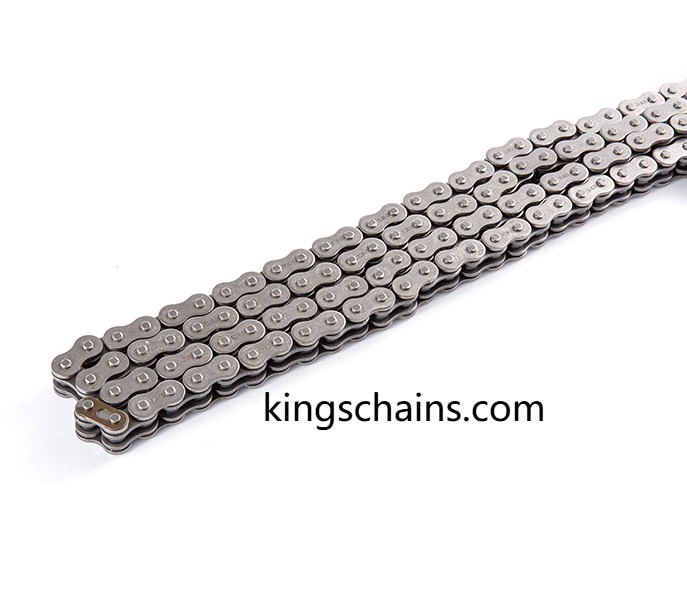
The materials used in a roller chain form the foundation of its mechanical construction. A typical chain contains inner plates, outer plates, pins, bushings, rollers, and connecting components, with each part performing a specific role during movement. Steel-based materials are commonly used because they can be processed into precise components and adapted to different transmission requirements. The relationship between these materials is more important than evaluating any single part independently, since the components must work together as the chain moves continuously around sprockets.
Component processing can have a direct influence on product consistency. Plates need to maintain suitable form, pins and bushings require controlled processing, and rollers must interact properly with sprocket teeth. Heat treatment can also be incorporated into manufacturing to develop appropriate characteristics for components that experience repeated movement and contact. Jiangshan Wangpai Chain Industry Co., Ltd. describes production capabilities that include high-precision punching, pin cutting, tube rolling, automatic quenching, assembly, and packaging processes.
Environmental conditions should be considered when selecting a chain. Industrial machinery may operate around dust, oil, moisture, or production residue, while agricultural equipment can encounter soil, vegetation, and outdoor exposure. A chain installed in a controlled indoor environment may therefore have different maintenance needs from one working in an exposed mechanical system. Buyers can communicate these conditions to the manufacturer before selecting a suitable chain construction and surface treatment.
Application compatibility is another important part of purchasing. The chain should correspond with the sprocket arrangement and the mechanical structure in which it will operate. Buyers can examine the transmission layout, surrounding components, operating environment, maintenance accessibility, and expected working conditions before confirming a product. Selecting a chain based only on appearance can overlook important differences in construction and application suitability.
Maintenance should also be considered before purchase. A chain may require regular inspection, cleaning, lubrication, and adjustment depending on its construction and operating environment. Maintenance personnel should be able to access relevant components without unnecessarily interfering with nearby machinery. A product that fits naturally into the existing maintenance workflow can make routine service more convenient for equipment operators.
Manufacturing technology is particularly important for buyers who require repeat orders. Production consistency depends on the relationship between material preparation, forming, heat treatment, assembly, inspection, and packaging. Jiangshan Wangpai Chain Industry Co., Ltd. states that it uses automated assembly lines and testing equipment covering areas such as hardness, tensile performance, length, metallographic characteristics, interlocking force, and fatigue performance.
For distributors and machinery manufacturers, quality consistency can influence inventory planning and customer service. A chain may be purchased repeatedly for the same equipment or supplied to different markets, so stable production helps buyers maintain a consistent product offering. Supplier evaluation can therefore include manufacturing equipment, inspection procedures, production organization, and communication capabilities rather than focusing only on the appearance of a sample.
Different chain constructions can serve different applications. Standard roller chain designs can support general mechanical transmission, while reinforced or specialized structures may be considered for more demanding environments. Wangpai's product portfolio includes motorcycle chains, industrial chains, and agricultural machinery chains, allowing customers to discuss different transmission requirements with one manufacturer.
Lubrication is closely connected with chain function and maintenance. Pins, bushings, rollers, and plates move in coordination, creating contact between components during operation. Suitable lubrication can help support smoother articulation and manage friction. The appropriate maintenance routine should follow the chain construction, equipment requirements, environmental conditions, and supplier guidance.
User experience also begins with installation. Clear product identification, appropriate connecting components, and compatibility with the existing sprocket system can make replacement work easier. Maintenance personnel benefit from chains that can be inspected and serviced in a practical way. For equipment manufacturers, these considerations can reduce unnecessary complexity during installation and routine maintenance.
Packaging is another practical aspect for distributors and OEM customers. Chains may move through factory storage, transportation, distributor warehouses, and service channels before reaching the final user. Organized packaging can help protect products during handling and make different chain products easier to identify. Wangpai's manufacturing system includes automatic packaging equipment as part of its production process.
For OEM and private-label projects, product presentation may involve packaging, labels, product identification, and surface appearance. A manufacturer capable of coordinating production with packaging requirements can make communication more efficient. This can be especially useful for companies developing their own replacement-parts programs or distributing chain products under a specific brand identity.
Design and appearance are not limited to packaging. The physical finish of a chain can influence how it looks when installed on visible machinery. Consistent plate forming, orderly assembly, clean surfaces, and an even finish can contribute to a professional appearance. While appearance should not replace mechanical compatibility, it can become relevant when chains are visible on motorcycles, agricultural equipment, or other machinery.
The choice of finish can also reflect different product applications. Industrial buyers may focus primarily on material compatibility and maintenance, while motorcycle and aftermarket customers may pay greater attention to surface appearance. Wangpai's product portfolio includes standard, reinforced, solid-bush, and sealed motorcycle chain categories, illustrating how chain construction and presentation can vary according to application needs.
Supplier communication is another part of the overall purchasing experience. Buyers can provide information about the machine, working environment, maintenance approach, packaging expectations, and intended market before production begins. Clear communication allows the manufacturer to understand the application rather than treating the order as a simple product-name request.
A manufacturer's production range can also matter when buyers manage several transmission applications. Jiangshan Wangpai Chain Industry Co., Ltd. describes itself as a manufacturer of motorcycle and industrial chains, while its product portfolio also includes chains for agricultural machinery. Its production system combines component processing, heat treatment, automated assembly, testing, and packaging, providing a basis for discussing different chain projects with one supplier.
For distributors, machinery manufacturers, agricultural equipment businesses, and replacement-parts suppliers, evaluating materials, construction, manufacturing processes, maintenance, installation, packaging, and appearance can create a clearer purchasing framework. These factors connect the chain with the complete transmission system and provide useful points for communication when developing repeat orders or application-specific products.
For more information about Jiangshan Wangpai Chain Industry Co., Ltd., its motorcycle chains, industrial chains, agricultural machinery chains, and related transmission products, visit https://www.kingschains.com/.