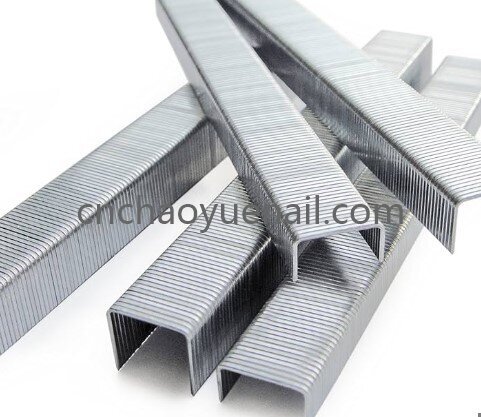
Reliable fastening products contribute to the quality and efficiency of furniture manufacturing, upholstery, packaging, and various industrial assembly processes. Fine Wire Staples are commonly selected for applications involving fabrics, thin boards, insulation materials, and other suitable substrates where a relatively slender fastening profile is required. Their performance depends on consistent steel quality, accurate forming, proper collation, and compatibility with the fastening equipment used during installation.
Material selection is the starting point of dependable staple manufacturing. Steel wire should provide consistent mechanical properties and a suitable surface condition for subsequent processing. Variations in material composition, hardness, or surface cleanliness may affect drawing efficiency and forming stability. Manufacturers therefore need to inspect incoming wire before production, checking for visible defects and material inconsistencies. Reliable raw materials help reduce production interruptions and improve consistency between manufacturing batches.
Wire preparation involves several coordinated operations. Drawing processes establish the required wire profile, while straightening equipment improves alignment before the material enters the forming line. Appropriate lubrication helps reduce friction and supports smooth wire movement through machinery. Automated feeding systems then deliver the prepared material to cutting and bending stations. These operations create the staple crown and legs, making stable machine settings important for maintaining consistent shape and alignment.
Precision forming is essential because irregular staple geometry may affect installation and tool feeding. Uneven crowns, inconsistent leg alignment, or rough cutting edges can create problems during fastening. Manufacturers should regularly monitor the condition of cutting blades, forming dies, and feeding guides. These components experience repeated mechanical stress and gradually wear during continuous production. Preventive maintenance, including cleaning, alignment checks, and timely tooling replacement, helps maintain stable output and reduce defective products.
Collation quality is another important consideration for staples used in pneumatic and electric fastening tools. Individual staples need to be arranged and bonded consistently so that they can move smoothly through the tool magazine. Poor bonding, irregular spacing, or damaged strips may cause feeding interruptions and unnecessary downtime. Manufacturers should inspect the collation process alongside the physical characteristics of individual staples. Buyers should also confirm that the product configuration matches their equipment requirements before placing bulk orders.
Surface finishing should reflect the intended application and storage environment. Bright steel may be suitable for many indoor applications, while galvanized or other coated finishes can be considered when additional corrosion protection is required. The appropriate choice depends on moisture exposure, substrate characteristics, and expected service conditions. Packaging and warehouse storage also influence product condition before installation. Buyers should communicate their requirements clearly to ensure the selected finish and packaging arrangement are appropriate.
Quality assurance should cover incoming materials, production operations, and finished products. Material inspections help identify unsuitable wire, while in-process checks monitor feeding, cutting, forming, and collation consistency. Final inspection may include visual assessment of product shape, surface appearance, and other characteristics specified by the customer. Automated counting and inspection systems can support high-volume production, while batch records help maintain traceability. These procedures allow manufacturers to investigate quality concerns and improve process control.
Packaging and logistics play an important role in maintaining product quality. Suitable inner boxes and cartons can protect staples from contamination, moisture, and unnecessary handling damage. Clear labels help identify product types, finishes, and production batches. Consistent packaging quantities also simplify warehouse management for distributors and industrial customers. For international shipments, manufacturers should consider transportation conditions and appropriate moisture protection to preserve product condition during delivery.
Responsible manufacturing practices can improve resource utilization. Accurate wire feeding and forming help reduce steel waste, while recoverable scrap can be separated for suitable recycling. Regular equipment maintenance reduces rejected production runs, and efficient packaging planning can limit unnecessary material consumption. These measures support organized production while maintaining attention to quality and supply reliability.
For distributors, furniture manufacturers, and industrial buyers, Fine Wire Staples should be evaluated through material consistency, forming accuracy, collation quality, and compatibility with the intended fastening equipment. Providing information about application materials, tool requirements, surface finish, and packaging preferences helps suppliers recommend suitable product options. To explore available fastening products and manufacturing capabilities, visit https://www.cnchaoyuenail.com/product for further information.