Manufacturing baking paper requires coordinated processes that transform suitable base materials into practical products for food preparation and commercial baking. When evaluating a Parchment Paper Factory, international buyers should consider raw material selection, silicone coating technology, converting accuracy, and quality management. These factors influence the consistency and usability of finished rolls and sheets. For wholesalers, distributors, and food manufacturers, understanding how products are manufactured can help establish clearer purchasing specifications and identify suitable options for different business applications.
Base paper selection is the starting point of production. Food-grade paper is commonly used for baking applications, subject to the specifications and compliance requirements of the intended market. Important characteristics include grammage, thickness, flexibility, tensile strength, and surface uniformity. These properties can influence coating compatibility, handling performance, and converting efficiency. Manufacturers need to select a paper structure appropriate for the intended product rather than relying on a single material specification for all customer requirements.
Silicone coating plays an important role in the production of non-stick baking paper. It creates a treated surface that helps reduce adhesion between baked products and the paper. This characteristic is useful for preparing cookies, biscuits, bread, cakes, and pastries. Coating performance is influenced by formulation, application conditions, drying, and the characteristics of the base paper. Consistent application is important because uneven coating may result in differences in surface performance. Manufacturers should establish suitable process controls according to the selected material and product design.
The production workflow generally includes incoming material inspection, paper unwinding, surface preparation, coating application, drying, rewinding, slitting, and packaging. Each stage has specific operational requirements. During unwinding and coating, appropriate tension control helps maintain stable paper movement. The drying process needs to correspond with the coating system, while rewinding equipment should produce orderly rolls suitable for subsequent converting or direct use. For sheet products, cutting precision is important for maintaining consistent dimensions and compatibility with common baking trays.
Quality management should cover both production processes and finished products. Incoming paper can be inspected against agreed material specifications before entering the production line. During processing, operators may monitor coating appearance, surface uniformity, and visible defects. Finished products can be checked for grammage, roll width, sheet dimensions, winding condition, and packaging integrity. These inspection activities help identify inconsistencies and provide a basis for maintaining product specifications across different production batches.
Different customer groups have different requirements for finished formats. Large food processing companies may purchase jumbo rolls for internal converting or high-volume production. Distributors may require smaller rolls suitable for wholesale and retail channels. Commercial bakeries, restaurants, and catering businesses may prefer pre-cut sheets because they simplify routine tray preparation. A manufacturer offering several converting options can accommodate different workflows and purchasing preferences without requiring every customer to use the same product format.
Grammage and dimensions should be determined according to the intended application. Reference grammage may range from approximately 30–60 gsm, depending on material design and customer requirements. Natural brown and white options may be available. Buyers can discuss roll width, roll length, sheet dimensions, and packaging configurations according to their equipment and distribution needs. These specifications should be confirmed before production begins, especially when products are intended for automated handling or standardized tray systems.
Packaging is another consideration in manufacturing and procurement. Jumbo rolls may require protective packaging suitable for transportation and storage, while smaller rolls and pre-cut sheets may need different packaging arrangements for distribution. Private-label customers may also request customized packaging details, product labeling, and different quantities per carton. Clear packaging specifications help coordinate production, inventory planning, and transportation arrangements between manufacturers and commercial buyers.
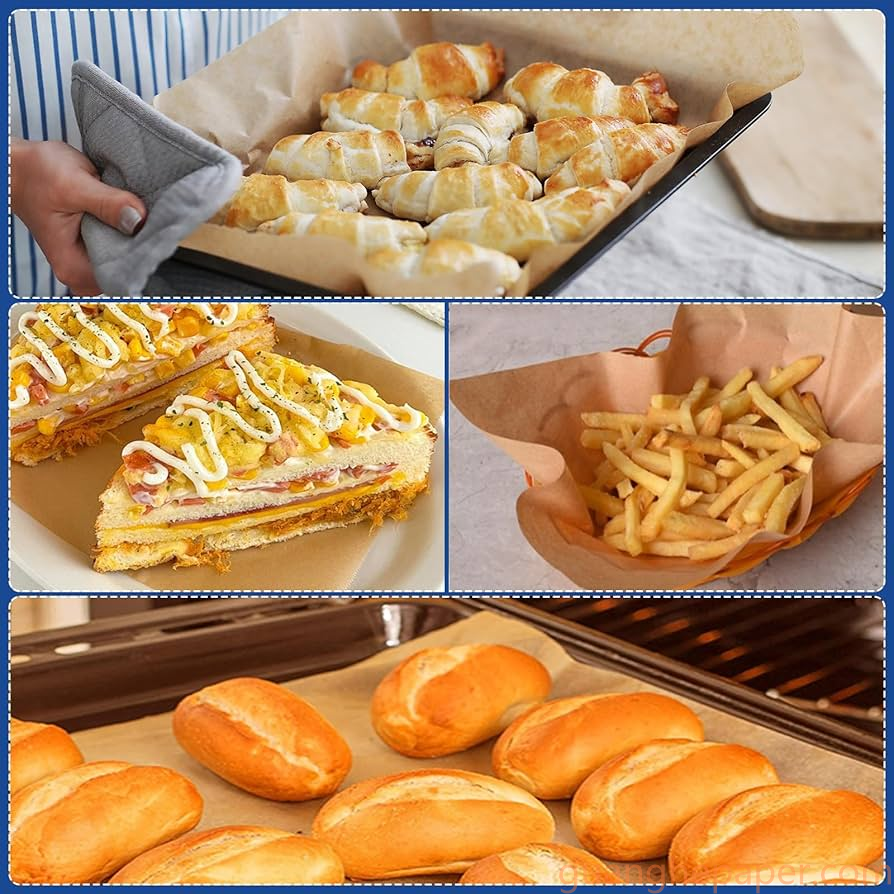
The products serve a broad range of applications, including cookie production, biscuit manufacturing, bread preparation, cake baking, and pastry processing. Restaurants and hotels may use smaller formats for kitchen operations, while industrial food processors may require larger rolls for repeated production activities. Buyers should also review temperature suitability and food-contact documentation for the specific product and destination market. General product descriptions alone cannot establish the compliance or operating limits of every material and coating combination.
Before placing bulk orders, purchasing teams can request samples and relevant technical information to assess material handling, coating characteristics, and dimensional compatibility. Clear communication about product specifications, order quantities, packaging, inspection requirements, and customization can help prevent misunderstandings during production. A Parchment Paper Factory should be assessed through its verified manufacturing capabilities and the suitability of its actual products for the buyer's application. Businesses reviewing available roll products and customized formats can consult https://www.guanghepaper.com/product/baking-parchment-paper-rolls-1/ when evaluating baking paper options for commercial procurement.