<!--StartFragment-->
Industrial machinery depends on mechanical transmission systems to convert motor power into controlled movement. Among the available transmission structures, the Industrial Rack And Pinion mechanism is widely used in equipment that requires rotational input to produce linear travel. Its straightforward operating principle, flexible installation possibilities, and compatibility with different machine structures make it an important option for automation equipment manufacturers, machine builders, and industrial engineering companies.
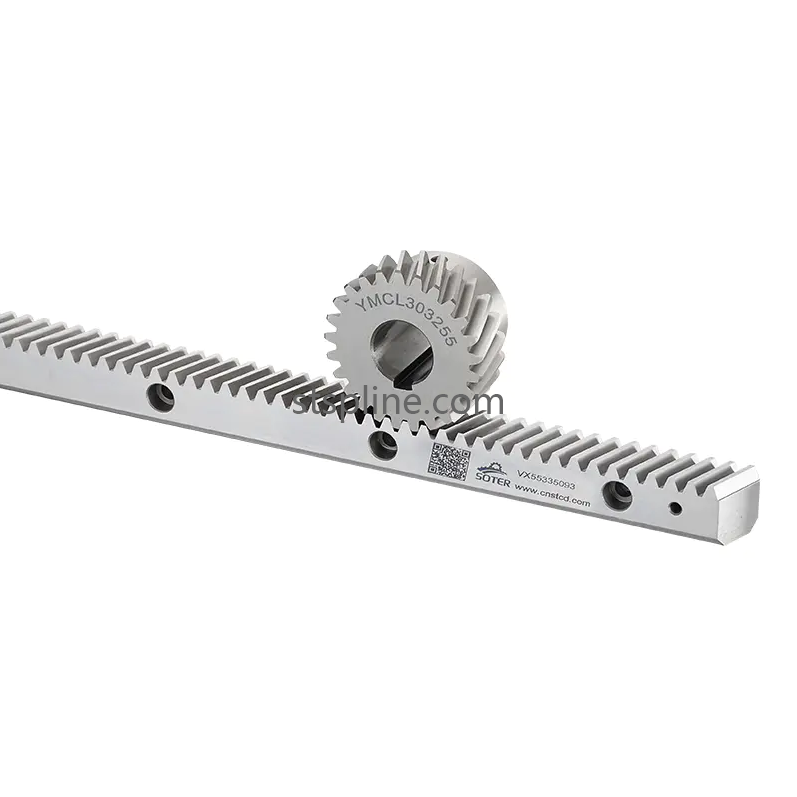
A typical rack and pinion system consists of a straight toothed rack and a circular pinion gear. The pinion receives rotational power from a motor or gearbox, and its teeth engage with the rack to generate linear movement. As the pinion rotates, the rack or the connected mechanical assembly moves along a defined direction. Depending on the machine design, the rack may remain stationary while the pinion travels, or the rack itself may move as part of the mechanical structure.
This transmission arrangement can be adapted to different machine configurations. In industrial equipment, the required travel distance, available installation space, load distribution, and movement frequency all influence the design. A compact automated positioning device may use a relatively short rack, while a large machine structure may require longer rack sections arranged along a common travel path. The appropriate configuration depends on the mechanical design and the relationship between the transmission components and supporting structure.
Material selection has a direct influence on manufacturing and service considerations. Steel is commonly selected for rack and pinion components because it offers useful mechanical properties and can be processed through established gear manufacturing methods. Depending on the application, manufacturers may consider carbon steel or alloy steel, together with suitable heat treatment or surface finishing processes. These choices should be evaluated according to contact conditions, operating environment, lubrication, and expected maintenance practices rather than based on material names alone.
The manufacturing process determines whether the finished components can engage correctly. Rack production may involve cutting, milling, grinding, and additional finishing operations, depending on the tooth geometry and accuracy requirements. Pinion gears require corresponding attention to tooth profile, pitch, concentricity, and surface condition. Inspection during and after machining helps identify dimensional deviations that could influence transmission behavior. Consistent production procedures are particularly important when several rack sections must work together in a single machine.
Gear geometry is another essential design factor. Module, pressure angle, tooth profile, and pitch determine how the rack and pinion interact. These characteristics must be compatible between the two components. If the geometry is not properly matched, the transmission may develop uneven contact, excessive backlash, or irregular movement. Engineers should therefore evaluate the complete gear pair rather than treating the rack and pinion as unrelated purchasing items. This approach is especially useful when replacing existing components or developing a new machine platform.
CNC machining centers are one important application area. Depending on the machine architecture, rack-driven systems can be incorporated into linear movement assemblies where motor rotation must be converted into travel along a machine axis. Laser cutting machines also use mechanical transmission components to move cutting structures and related assemblies. In these applications, the mechanical system must work together with guide rails, motors, control units, and supporting structures to provide coordinated movement.
Industrial robots and truss manipulators offer further examples of rack-based transmission applications. Automated handling equipment often needs to move workpieces between processing stations, and the transmission system must fit the machine's travel path and structural arrangement. Automotive automation production lines may incorporate linear drive components in material transfer systems, assembly stations, and positioning equipment. Lithium battery automation machinery and intelligent manufacturing systems also require coordinated mechanical movement across different production stages.
Correct installation is necessary to achieve stable operation. The rack should be mounted on a suitable reference surface, with attention to straightness, parallel alignment, and fastening consistency. The pinion mounting position must allow appropriate tooth engagement throughout the travel range. Where multiple rack sections are connected, the joints should be arranged carefully to maintain consistent tooth spacing and smooth movement. Assembly teams should follow the machine design documentation and inspect the transmission before putting the equipment into regular operation.
Maintenance practices depend on the operating environment and machine duty cycle. Dust, metal particles, moisture, and inadequate lubrication can affect the contact surfaces of the gear pair. Regular cleaning and inspection help identify contamination, unusual wear, loosened fasteners, or changes in engagement. Lubrication should follow the recommendations for the specific equipment and transmission arrangement. If abnormal noise or movement appears, technicians should examine alignment and component condition before assuming that the gear itself is the only source of the problem.
For B2B procurement, buyers should evaluate the supplier's manufacturing capability, product consistency, inspection methods, and technical communication. It is helpful to provide drawings, samples, installation information, and application details when requesting quotations. These materials allow manufacturers to assess the required tooth geometry, dimensions, material, and processing methods. Buyers should also clarify whether matching pinions, customized lengths, and related transmission components can be supplied as part of the same project.
Choosing an appropriate Industrial Rack And Pinion system requires attention to the complete mechanical application, from power input and gear engagement to installation and maintenance. Zhejiang Soter Transmission Technology Co., Ltd. has specialized in rack and gear manufacturing since 2006, serving industrial equipment customers with production and inspection capabilities and customization based on drawings and samples. Its product range supports applications in CNC machinery, laser cutting equipment, robotics, and automated production systems. More information about its rack solutions is available through the https://www.stspline.com/product/straight-teeth-rack/ product page.
<!--EndFragment-->